Electricity
Hand-Crank Generator
Put that excess student energy to good use. Excellect demonstration of the conversion of muscle energy to kinetic energy to electrical energy. Maximum current output is 0.2 A and 6.3 volts DC. Comes with light bulb and removable leads.
ELEC.107a $39.95 each
Small Electric Motor (round shape)
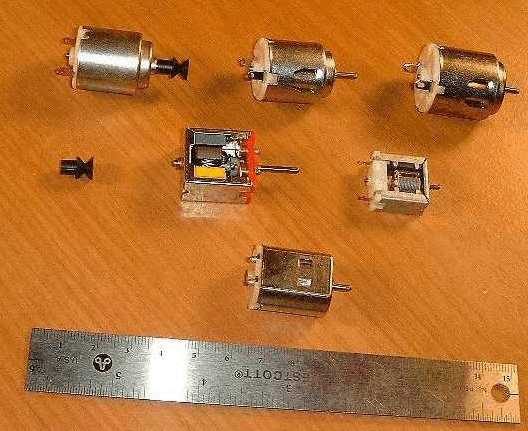
Our most popular electric motor. Excellent quality, low torque, silent operation. Battery operated (batteries not included), suitable for powering small cars or other moving models, 0.5 to 3 volts DC (single or double battery operation: AA , C or D cells). Convenient, sturdy leads, standard shaft diameter. Fits into ELEC.023, motor mounting clip. Ideal for running low voltage solar powered models.
ELEC.013 $4.95 each
Motor Shaft Pulley
Just the size to fit on the drive shaft of ELEC.013 and ELEC.045. This wee bit makes it easy to transfer the rotational energy of the motor shaft to another pulley or wheel via a rubber band.
ELEC.021 $1.00 each
Small Electric Motor, round, with motor shaft pulley
This consists of one item ELEC.013 plus one item ELEC.021. Highly recommended for battery-operated cars, in tandem with PULL.07 on the car axle to form a two-pulley plus elastic band "power transfer" arrangement, similar to a fan belt system in a regular automobile.
ELEC.022 $5.95 each
Motor Mounting Clip
Plastic mounting clip to securely attach the round motors (items ELEC.022, ELEC.013 and ELEC.045) to a flat surface. Self-adhesive base.
ELEC.023 $2.25 each
Alligator Clips
(Clips only, no wire! See next item for Alligator Clip Wire.) Non-insulated metal spring-loaded clips for electrical connections. With these and some plain copper wire, you can make your own custom-length Jumper Clip Wires.
ELEC.002 1.25" length, single $0.50 each
ELEC.018 1.25" length, package of 10 $3.95/pkg
ELEC.027 2" length, single $0.75 each
ELEC.028 2" length, package of 10 $6.95/pkg
Alligator Clip Wire (a.k.a. Jumper Clip Wire)
Easy and elegant electrical circuits! Not to be confused with plain old ordinary Alligator Clips (above). Insulated copper wire (18" long) with an insulated alligator clip on each end.
ELEC.026 package of 10 $8.95/pkg
ELEC.030 single $1.00 each
Copper Wire, solid
Solid conductor wire, copper with vinyl coating. Just what you need to complete experimental electrical circuits. The 22 or 24 gauge wire is also known as "bell wire" or "hook up wire". The 18 gauge wire is thicker and more stiff, and some folks find it easier to work with. Note: The copper conductor of this wire may or may not be coated with a thin layer of tin (depends on the manufacturer/supplier). This is to make soldering easier, and does not affect the conductivity of the wire, only the colour of the actual metal conductor. (This wire does not have to be soldered, it can be used without soldering after stripping a small amount of insulation off the ends to expose the conductor.)
ELEC.016 22 gauge (pretty thin) $0.25/foot
ELEC.024 18 gauge (thicker) $0.25/foot
ELEC.025 18 gauge (10 metre coil) $5.00/roll
ELEC.108 24 gauge, bundle of 50 wires, 1 metre each $12.95/pkg (Total of 50 metres, BEST DEAL!)
Nickel-Chromium Wire (Ni-Chrome Wire)
Used to perform resistance experiments with electricity. A short piece of this wire gets REALLY hot when connected to a circuit, even with only one single D cell. (Warning: Can cause burns if used improperly - Believe me, I know! Fire hazard!) Using the proper safety precautions, try to get it to actually glow, like the filament in a light bulb. HOT HOT HOT! This material is bare wire only, with no coating. Priced per metre, packaged in one metre lengths, because that is how most teachers request it. (It is also much easier to handle in these short lengths - up to one metre. Longer lengths tend to tangle and kink too easily.) If you require a continuous piece of ni-chrome wire greater than 1 metre in length, please indicate the full length you wish and be sure to mention that you want it in one continuous piece. Otherwise, it is normally packaged in 1 metre lengths.
ELEC.076 22 gauge $1.00/metre
ELEC.071 32 gauge $1.00/metre
Magnet Wire
Spool of 400 feet 32 gauge solid conductor copper wire, enamel coated. Excellent for making electromagnets with a nail and a battery, or for winding your own armatures to make working model electrical motors. This stuff is really thin, and difficult to handle if you take it off the spool. NOT for everyday classroom circuit wiring.
ELEC.059 $5.95/spool
Contact or Toggle Switch ("Knife Switch") (blue base)
An economy switch designed for low-voltage circuit applications. Used as is, it is designed for applications that require continuous flow of current once switch is closed (like a typical wall switch). Simple bending upwards of the contact "handle" makes this into a push switch for applications that require momentary completion of circuits (like a doorbell). Made from durable moulded plastic with metal Fahnestock clips for wire attachments.
ELEC.004 $1.50 each
Classic Knife Switches
These are the style of electrical switch that is popular with model train enthusiasts and in Dr. Frankenstein's laboratory. Rectangular plastic bases. The ones with posts provide an easier connection when using plain stripped wire ends, as the connection is simply a finger-tightened knob and does not require any tools. The ones without posts usually require a screwdriver to make connections with bared wire, but either can be used with Jumper Clip Wire. Single Throw just means simple on and off positions. Double Throw means you can create "Circuit 1 - Off position - Circuit 2" arrangements. Not sure what special applications you would use the "Double Pole Double Throw" one for, but it looks cool.
ELEC.096 Switch, "classic" knife switch, SPST (single pole single throw) with posts $4.95 each
ELEC.097 Switch, "classic" knife switch, SPDT (single pole double throw) $5.95 each
ELEC.098 Switch, "classic" knife switch, SPDT (single pole double throw) with posts $5.95 each
ELEC.099 Switch, "classic" knife switch, DPDT (double pole double throw) $5.95 each
Contact Key / Telegraph Key
Also known as a Tapping Key, as in tapping out Morse Code. Can also be used as a simple momentary on/off switch for lights, buzzers, etc. Mounted on a bakelite base, easy screw and post attachments for wires.
ELEC.054 $6.95 each

Mini Light Bulb, screw base
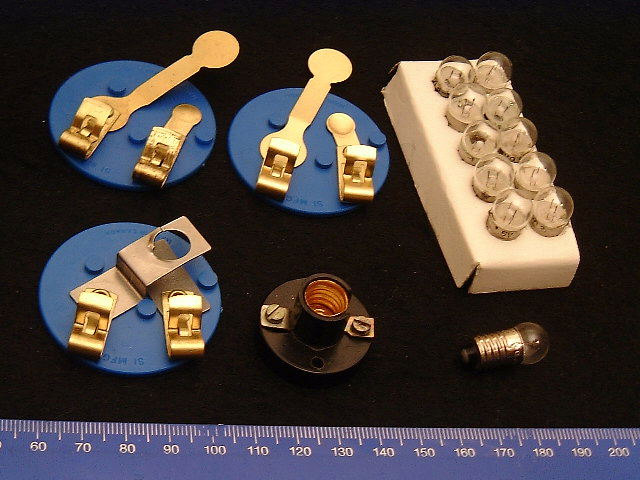
Also known as mini electric lamps, or lamp bulbs. The 1.5 volt ones are likely to burn out if attached to more than 1 battery. 1.5 and 2.5 volt work on one battery (AA, C or D cell). The 2.5 volt ones are the most popular, as they will work with either 1 or 2 batteries. The 3.5 - 3.8 volt bulbs will only feebly work with one battery, as they are designed to have more voltage applied. The 6 volt bulbs are designed for use with the large 6 volt square or rectangular lantern-type batteries. All will fit screw base bulb holders below (ELEC.015, ELEC.083 and ELEC.094).
ELEC.050 1.5 volt, single bulb $1.50 each
ELEC.051 1.5 volt, set of 10 $12.95/set
ELEC.014 2.5 volt, single bulb $1.50 each
ELEC.029 2.5 volt, set of 10 $12.95/set
ELEC.039 3.5 - 3.8 volt, single bulb $1.50 each
ELEC.040 3.5 - 3.8 volt, set of 10 $12.95/set
ELEC.043 6 volt, single bulb $1.50 each
ELEC.044 6 volt, set of 10 $12.95/set
Mini Bulb Sockets/Holders
Screw base for Mini Light Bulbs (above). ELEC.015 is small metal socket only, with no plastic base. ELEC.083 has the black (or white) plastic base style similar to a miniature version of the bulb holder you may have on the ceiling of your basement or garage. ELEC.094 comes with Fahnestock clips and a flat blue plastic base (similar style to the blue base switches ELEC.03 & ELEC.04 - see above).
ELEC.015 metal socket only - no "base" $1.00 each
ELEC.083 "Classic" bulb holder $1.50 each (Usually either black or white plastic. Sorry, no colour choice. It depends on what our supplier sends us.)
ELEC.094 blue base $2.50 each
Mini DC Buzzer
Designed for battery operation, works with as little as 1.5 volts DC (single AA, C or D cell). We have customers who purchase these to make a "game show" set up for a panel of students to answer questions. If the buzzer does not work when you hook it up, try reversing the battery connections, as the polarity must be correct.
ELEC.005 $5.95 each
Battery Holders
All are easily connected to circuits using alligator or jumper clip wire, or if supplied with +/- wire leads attached, use the small portion of already-exposed metal at the wire tips to make your connetions. Stripping of the plastic coating to expose more metal (supposedly for a "better connection") is not recommended, as the wire is fairly thin and can easily be cut by mistake.
ELEC.032 9V snap clip with wire leads $0.50 each
Note: most of our products are NOT designed to be used with 9V batteries.
ELEC.078 Holds 2 AA batteries, +/- wires attached $1.95 each
ELEC.101 Holds 1 C cell, +/- wires attached $1.95 each
ELEC.102 Holds 2 C cells, +/- wires attached $2.50 each
ELEC.084 Holds 1 D cell, +/- wires attached $1.95 each
ELEC.089 Battery Holder for D cell, blue plastic, multiples can be arranged as series or parallel connections $2.95 each
Batteries
We have AA, C and D cell batteries available. 1.5 volts each.
BATT.004 single AA cell $0.50 each
BATT.006 single C cell $1.00 each
BATT.002 single D cell $1.00 each
Electrode Elements
Great for science fair projects. Flat strips of metal except for ELEC.011 and ELEC.011a. Size will vary among different suppliers, but generally at least 4 inches long. Used to make "wet cell" (voltaic cell), OR use them to make your own fruit-powered clock!
ELEC.006 Nickel electrode element $14.00 each
ELEC.007 Aluminum electrode element $6.00 each
ELEC.008 Iron electrode element $7.00 each
ELEC.009 Lead electrode element $6.00 each
ELEC.010 Copper electrode element $7.00 each
ELEC.010a Copper electrode element, thin strip $5.00 each
ELEC.011 Carbon electrode element (round) $6.00 each
ELEC.011a Carbon electrode element (bar shape) $8.00 each (5" long, 1" wide, 1/4" thick)
ELEC.012 Zinc electrode element $7.00 each
ELEC.012a Zinc electrode element, thin strip $5.00 each
ELEC.047 Brass electrode element $7.00 each
ELEC.062 Tin electrode element $10.00 each (nearly pure tin metal, NOT tin plated stuff)
ELEC.079 "Tin" electrode element, Tin plated iron? $1.00 each (this is the tin plated stuff)
ELEC.091 Bronze electrode element $8.00 each
ELEC.092 Stainless Steel electrode element $7.00 each
ELEC.093 Magnesium electrode element $7.00 each
Ebonite Rods
Rub with different types of cloth to produce small amounts of static electricity.
ELEC.052 $6.00 each
Static Electricity Kit
Contains one each of: Ebonite Rod (available separately above), thick glass rod, HDPE rod, acrylic rod, PVC pipe, as well as swatches of rabbit fur, wool, cotton, silk, and rayon/polyester blend materials. Also contains package of balloons, comb, string, Styrofoam pieces and useful background material.
ELEC.118 $27.95 kit
TOPS Module #19 - Electricity
This book begins with task cards that investigate the nature of like and unlike charges, establishing the reason why current flows through wire. Students then improvise bulb and battery holders and build a variety of different switches. They will then configure them in parallel and series arrangements, using Ohms Law to predict how the current will flow. Your class will construct all manner of wonderful inventions: galvanometers, variable resistors, fuses, electroscopes, wet cells, storage cells, ammeters and more. They can even split water and recombine the gasses in a safe mini-explosion (Do not panic, it's just a "pop"). Book of 36 lessons for grades 8 to 12.
TOPS.19 Electricity $26.95
ELEC.113 Capacitor and 2 Resistor "set" to accompany TOPS.19 $4.95

TOPS Module #32 - Electricity
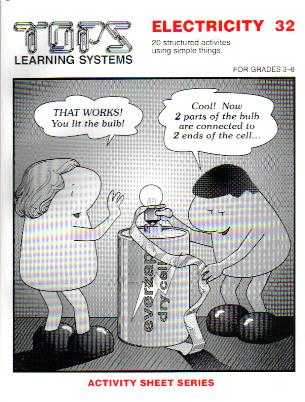
Circuits are fun to build. But poor contact points or loose connections can often make it a frustrating experience, especially for younger students. Not to worry! Using no more than paper clips, rubber bands, clothespins and pennies, your students will build bulb holders, battery holders and switches that are virtually goof-proof. Gone is the tangle of copper wire that must be twisted and untwisted. It is replaced by flexible, tangle-proof ribbon - aluminum foil backed by masking tape. Because they are flat, these ribbons can be joined into electrically secure connections with paper clips. Simple, inexpensive, easy to do - you and your class will love Electricity. Book of 20 lessons for grades 3 to 8.
TOPS.32 Electricity $26.95
Worlds Simplest Motor Kit
Easy and fun to build, for ages 8 and up. Requires one D cell battery. Uses a small permanent disk magnet (included). This small model motor actually works, but it is not strong enough to power anything. Provides a good model of how a DC motor works. Comes with instructions.
ELEC.104 $7.95 each
Basic Battery Car Kit
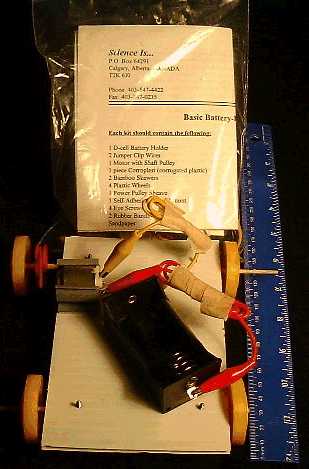
Build a simple battery-operated car that will scoot across the floor under its own power. Not much to look at, as it is basically a flat piece of plastic with wheels, a motor and a power source. But most of the parts can be easily disassembled to be used to create many other battery-powered units.
KITT.25 $18.95 each
 See some examples of Battery-Powered Vehicles made by Calgary students.
|
TEACHERS! We can design custom electrical vehicle kits to fit your budget. In the Calgary area, we can also do a low-cost ($50.00 + GST) minimum 90 minute student workshop on simple electrical circuits and building a battery operated vehicle. Call for bookings. No obligation to purchase materials from Science Is..., but please allow us to distribute parts lists for the use of your students. Most teachers find this quite useful, as students often complain about not being able to locate the parts needed for the project. If they decide to purchase materials from Science Is... through the school workshop, we will pack each student order individually & we offer FREE delivery (within Calgary city limits) to the school to fit your schedule. |
Radiometer
This has got to be the coolest science toy around! A clear glass bulb, partially evacuated, contains 4 vanes or wings balanced on a virtually frictionless pin bearing. The vanes are black on one side, white on the other. When placed in sunlight or under a bright incandescent lamp, the vanes will spin around. The brighter the light, the faster the vanes will spin. Very fragile, for ages 12+.
SOLR.08 $19.95 each